
● Prize list A: Prizes offered for
solving teaching challenges (volumes I to V)
● Prize list B: Prizes offered for special
achievements (volumes I to V)
● Prize list C: Prizes offered around the strand
model (volume VI)
● Prize list D: Prizes offered for graphics and
animations
● Prize winners for previous challenges
● Possible Theses and Papers
The six volumes of the free physics text contain over 1700 challenges in physics and maths. Some solutions are not included. For challenge solutions of particular didactic or research value I offer special prizes. The first good solution I receive will be added to the free physics textbook, together with the sender's name. Partial prizes may also be awarded. To apply for a prize, mail a solution to christoph@motionmountain.net. Prize list B is for special achievements. Several challenges from prize lists C and F could lead to publications, form chapters in a PhD thesis, or both.
A few even newer mathematical prizes are found on the "charge-mass" page. All prizes are for the first solution sent in. (Der Rechtsweg ist ausgeschlossen.)
Prize list F: Favourite strand challenges and prizes offered for their
solution:
Challenge F 3: Determine, using the tangle model, the mass ratio between the neutrinos and the electron. Prize: 500 €. The result is worth publication.
Challenge F 4: Determine, using the tangle model, a better approximation for the fine structure constant than 1/126. Prize: 500 €. The result is worth publication.
Challenge F 5: Determine how the probability of belt-trick-like rotation for a polymer-tethered ball depends on the chirality and size of the ball and on the number of polymer chains. First, look at this video. Then, imagine that the belts are exchanged by two parallel cylindrical polymer chains, and that there are not only 4, but 2n of them; also imagine that the central buckle is a chiral structure. In the strand model, the probability for the belt trick is related to the absolute mass of the elementary particles. So solving this polymer problem in detail will also advance particle physics. The solver will receive a special prize plus an amount of at least 500 euro. The result is worth publication.
Challenge F 6: Falsify any of over hundred strand predictions, with experiments or other arguments. The prize will be substantial. Please write to set terms together. The result is worth publication. Even if you do not write, the head of the experiment will get an invitation to dinner.
Challenge F 7: Prove, clarify or disprove this conjecture: no visualization of SU(2) or SU(3) without tethers is possible in 3 dimensions. Prize: 50 €. The result is worth publication.
Challenge F 8: Prove, clarify or disprove this conjecture: no non-equivalent visualization of SU(3) to the one with three strands is possible in 3 dimensions. (A triangular belt buckle with three attached belts attached with hinges does not count as "inequivalent".) Prize: 50 €. The result is worth publication.
Challenge F 9: Prove, clarify or disprove this conjecture: no visualization of SU(n) with strands for n > 3 is possible in 3 dimensions. (This would have profound consequences for physics, including the lack of GUTs.) Prize: 50 €. The result is worth publication.
Challenge F 10: Prove, clarify or disprove this conjecture: no visualization of SU(n) with n > 3 is possible in 3 dimensions, of any kind. Prize: 50 €. The result is worth a publication.
Challenge F 11: Prove, clarify or disprove this conjecture: the rational tangle classification is mathematically complete and leaves no room for additional elementary fermions or bosons. (This clarifies the options for dark matter.) Prize: 150 €. The result is worth a publication.
Challenge F 12: Prove, clarify or disprove this conjecture: the rational tangle classification is mathematically complete and leaves no room for additional defects in space that are neither fermions nor bosons. (This clarifies the options for dark energy.) Prize: 50 €. The result is worth a publication.
Challenge F 13:
Prove, clarify or disprove this conjecture: the
3d writhe of rational 3d tangle is quantized (similar to that of knots)
and determine the size of the
writhe quantum for 3d tangles. Prize: 200 euro. The result
is worth a publication. I would help in writing the paper.
(Note: For ideal, i.e., tight knots, 3d writhe is quantized in (certain) multiples of 1/7.
Maybe the number of strands plays a role in the quantization of 3d writhe.
Maybe the 3d writhe of a tight rational 3d tangle is proportional to 2d writhe.
It is sufficient to provide a solution only for alternating tangles, or
only for tangles made of two
or three strands given in Figure 25 in the preprint
 Testing a model for emergent spinor wave functions
explaining gauge interactions and elementary particles.
Testing a model for emergent spinor wave functions
explaining gauge interactions and elementary particles.
PRIZE LIST A: Prizes offered for solving teaching challenges (volumes I
to V)
Challenge A 2: The 'tangles inside a sphere' problem. This problem combines topology, statistics and geometry. Estimate the number of topologically different tangles that can fit into a sphere of given volume, with the assumption that every strand, though flexible, has constant diameter. A glass sphere of radius R contains n strands of diameter d (d<R), all starting and ending on the surface (at 2n given and fixed points distributed over the surface). How many topologically different tangles can be formed, under the condition that the diameter d has the largest possible value for a given n? [Note: in mathematics, one distinguishes trivial, composed, rational, locally knotted and prime tangles. The problem asks for the number of possible tangles that are composed or prime. Locally knotted tangles may be left out of the counting; rational tangles do not count as topologically different in this problem.] Prize: 1000 euro – and publish the solution! One attempt so far.
Challenge A 3: Classical Lagrangian for waves. Use the relation for the errors in angular frequency and time for wave packets, dw dt > 1/2, to show that the classical action for a wave is bounded below. Find the precise bound by assuming that the initial and final points for which the action is determined must themselves obey the wave packet relation. Prize: 100 euro. The result should be published.
Challenge A 4: Rotation in special relativity. Make a movie of a sphere/football with relativistic speed and relativistic rotation speed. Show the strange effects that appear. Prize: 100 euro. The result should be published. Half an attempt so far.
Challenge A 5: The simplest unsolved knot problem. Imagine an ideally wobbly rope, that is, a rope that has the same radius everywhere, but whose curvature can be changed as one prefers. Tie a trefoil knot into the rope. By how much do the ends of the rope get nearer? In 2011, there are only numerical estimates for the answer: about 10.1 diameters. There is no formula giving the number 10.1 yet - can you find one? Alternatively, solve the following problem: what is the rope length of a closed trefoil knot? Also in this case, only numerical values are known - about 16.33 rope diameters - but no exact formula. Prize: 500 euro from me, plus eternal fame. The result should be published. Two attempts so far.
Challenge A 6: Extending the belt trick to spin 3/2. The Dirac belt trick simulates the behaviour of a spin 1/2 particle. What is the construction for a composed spin 3/2 particle? For an elementary spin 3/2 particle? Prize: 50 euro. One attempt so far.
Challenge A 7: Taking a combined photograph of a rainbow, similar to the one by Stefan Zeiger, but including a third segment with the ultraviolet picture. Prize: 50 euro.

Challenge A 8: Explain the problems in performing a Bohm-type experiment with two nuclei that are first near each other and then separated. Prize: 50 euro.
Challenge A 9: Convince Adobe to eliminate an ugly and old bug: in Adobe Reader, horizontal line thicknesses are shown on screen irregularly in wrong, usually exaggerated thicknesses. That makes tables look horrible. The bug has been noted and communicated to Adobe by many since version 1 of the program; it is still present in version XI. This one will receive a special reward, because even several Adobe engineers gave up on the topic in the past. The reward is 50 euro plus a paper copy of the 6 volumes signed by the author, with a special thank you letter in the name of all graphics artists worldwide. Three attempts so far.
Challenge A 10: Supply valuable details on the mathematics of tree growth: the laws about their proportions, the height of their trunks, as derived from the principle of minimum effort, etc. Prize: 50 euro. Two attempts so far.
Challenge A 12: Provide figures of the most important topological defects: twirls, hedgehogs, etc. Prize: 10 euro.
Challenge A 15: Supply beautiful and clear photos for wave interference, polarization, diffraction, refraction, wave damping, and wave dispersion. Prize: 20 euro each.
Challenge A 16: Write an article about the site and book in a newspaper or journal. Prize: a paper edition.
Challenge A 17: Find a research literature reference for the difficulties encountered when trying to observe classical tachyons, i.e. the difficulties encountered when a classical tachyon (assuming it exists) flies across your field of view. (There is a better reference than Recami, somewhere, I know it from hearsay. There is also a website somewhere, I saw it and lost it in 2014.) Prize: 50 euro. One attempt so far.
Challenge A 18: Take and send in pictures or films about striking examples of motion in biology or in any other field - with permission of use. Prize: 50 euro.
Challenge A 19: Propose good solutions to challenges marked as "ny". Prize: 10 euro each.
Challenge A 20: Propose counter-examples to maximum force, maximum power, or maximum mass flow. Prize: 200 euro for valid ones, 10 euro for false, but good ones.
PRIZE LIST B: Prizes offered for special achievements (volumes I to V)
Challenge B 1: Propose substantial improvements to the text. I will reward your input in a way that is comparable to the other rewards listed here.
Challenge B 3: Translate untranslated parts of the text into Spanish, Italian, German, French or any other language. Click here for details on how to do it and then let me know. I will find a way to reward your efforts appropriately.
PRIZE LIST C: Prizes offered for challenges about the strand
model (volume VI)
Challenge C 2: Determine the probability of twists (Reidemeister Type I moves) for a chiral tangle made of two or three strands. Show that the square of the probability is 1/137.036. Prize: 1000 euro. The result is worth a publication.
Challenge C 3: Determine, from the strand model, how the mass of the W and Z bosons run with energy. Prize: 500 euro. The result is worth a publication.
Challenge C 6: Deduce, using the strand model, an analytical approximation for particle mass ratios or particle masses. The approximation could be based on ropelength or on the W/Z mass ratio calculation - but does not have to be. Prize: 1000 euro. The result is worth a publication.
Challenge C 7: Find, using the strand model, an analytical approximation for probabilities of core shape changes. Prize: 1000 euro. The result is worth a publication.
Challenge C 9: Describe, for the strand model, the relation between strand distance and the modulus of the wave function. Prize: 50 euro.
Challenge C 10: Deduce in a simple way, for the strand model or for textbook quantum mechanics, Schwinger's quantum action principle from the quantum of action. Prize: 100 euro. The result is worth a publication.
Challenge C 11: Find, for the strand model, a simple visualization of the weak mixing angle, also called the 'Weinberg angle'. Prize: 100 euro. The result is worth publication.
Challenge C 13: Describe, for the strand model, the precise phase choices for a crossing that lead to SU(3) invariance. Prize: 200 euro . The result is worth publication.
Challenge C 14: Visualize, for the strand model, the relation between SU(3) in the harmonic oscillator and SU(3) due to the third Reidemeister move. Prize: 200 euro. The result is worth publication.
Challenge C 15: Check the six basic lepton tangles and estimate their ropelengths. Prize: a surprise. The result is worth publication.
Challenge C 17: Confirm or invalidate the new W and Z tangles defined with the help of strands. Prize: a surprise. The result is worth publication.
PRIZE LIST D: Prizes offered for graphics and animations
Challenge D 2: Produce animations about the
spinning tangles of quarks, leptons and certain bosons
in Shadertoy, with the same look as in Challenge D1 (but coloured),
and without the errors (write me first) visible here:
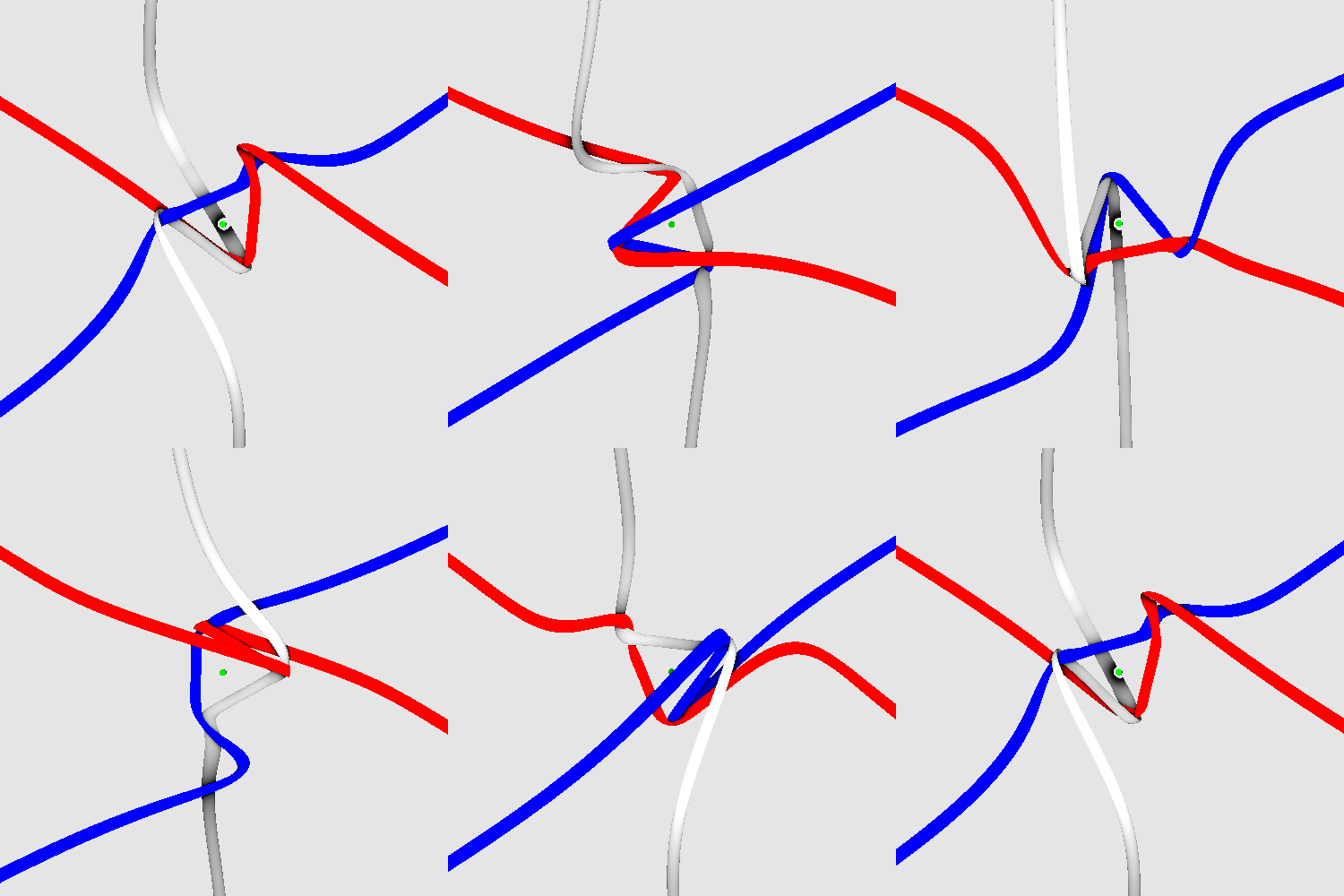 Spinning electron.
 Evolving photon.
Prize: 50 € for each quark and for each lepton, 30€ for the photon.
The animations will be used in publications, on Twitter, Mastodon and on
these web pages.
Challenge D 4: Produce animations about
the three gauge groups U(1), SU(2) and SU(3) in Shadertoy, based on the top of
Figures 5 and 6, and on Figure 8 shown in this paper.
(They should be 3d interactive, to allow different observation directions.)
An example (Figure 6) would be these three animations:

Details and prize to be discussed together. The result will be used in publications,
on Twitter, Mastodon and on web pages.
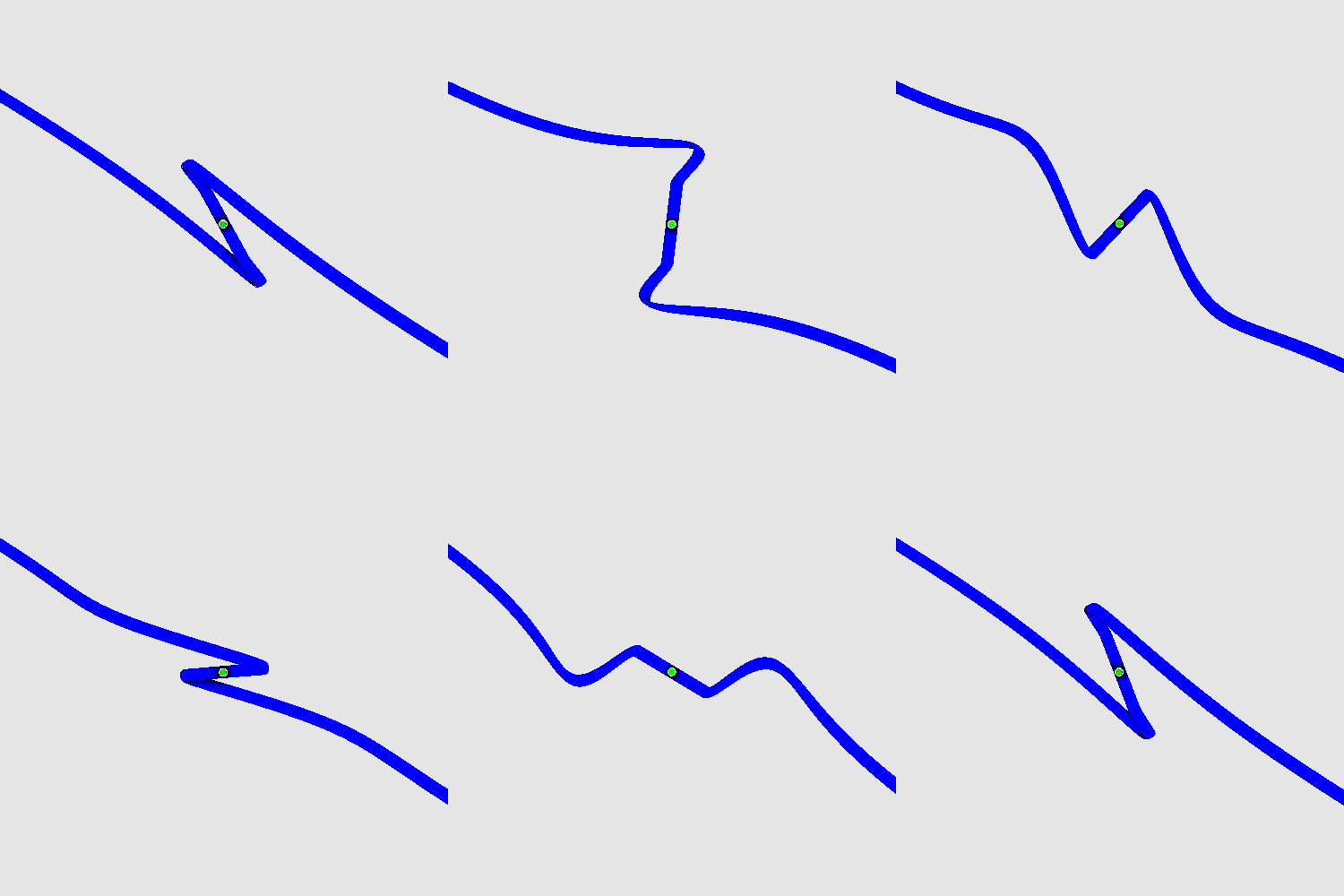
Challenge D 5: Produce an animation (if possible in
Shadertoy, but this is not required) about the origin of wave functions
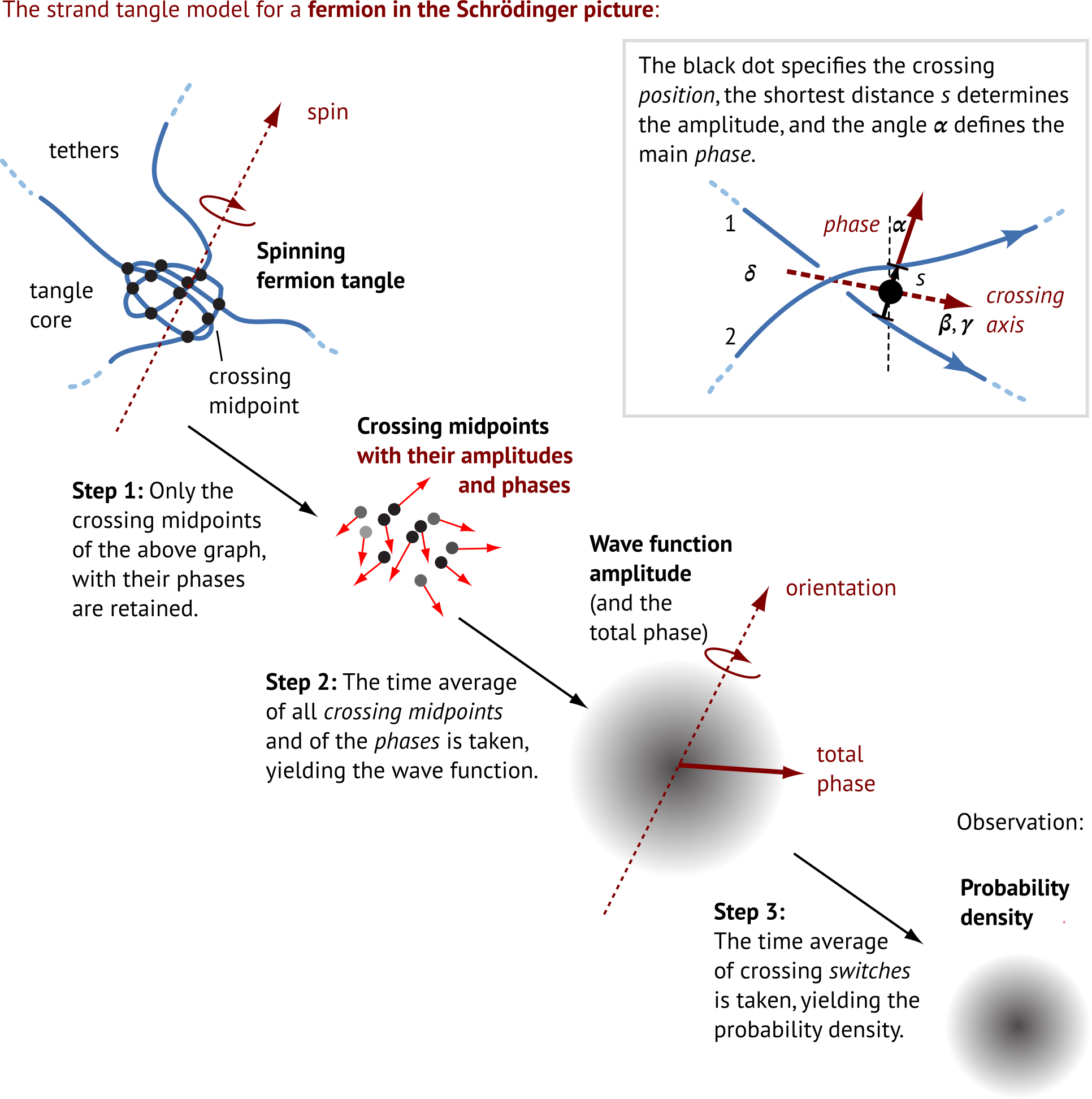
Prize: to be decided.
The result will be used in publications, on Twitter, Mastodon and on web
pages.
Challenge D 6: Produce animations about
the gauge interactions and the Higgs interaction in Shadertoy, based
on challenge D4. (They should be 3d interactive.)
Details and prize to be
discussed together. The result will be used in publications,
on Twitter, Mastodon and on web
pages.
PRIZE WINNERS for previous challenges
Solved challenge A 1: The parking problem. Find the minimum number of times one has to drive backwards and forwards to leave from a parking space, when the available space and the geometry of the car are given. Look up the details by searching for 'car parking' in the book index. After several attempts by others, the prize has been awarded to Daniel Hawkins.
Solved challenge A 11: Provide a research literature reference for the diffusive speed of light in the solar interior. Prize awarded to Zach Espiritu.
Solved challenge A 13: Send in a quality CAD drawing of a Foucault gyroscope. Prize also awarded to Zach Espiritu.
Solved challenge A 14: Take and send in a beautiful and clear photograph of how a candle flame reacts to a rubbed comb or, better, of how it splits in a high electric field. Prize awarded to Shubham Das and Rakesh Kumar.
Solved challenge A 20: Produce an animation that is unique throughout the world, one that shows clearly how two belts behave as fermions under exchange, complementing the now standard visualisation that a belt behaves like a fermion under rotations. Together with the usual belt trick, the animation would thus visualize the spin-statistics theorem for spin 1/2. The ideas and the original physical behaviour to be shown are straightforward, but the graphic work will take a bit of patience. The resulting animation would extend the applet shown at http://www.gregegan.net/APPLETS/21/21.html to a situation with two belt buckles and four belts. If you are interested, get in touch with me. One option could be to start with the software at www.cs.indiana.edu/~hansona/quatvis/Belt-Trick/index.html and then expanding it. The resulting animation will be unique world-wide, and I would build it into the text. The prize goes to Antonio Martos for his wonderful animation.
*
Solved challenge C 4: Extrapolate the measured up and down quark masses to Planck energy, using the standard model. Solved by Shun Zhou.
Solved challenge C 8: Formulate, for the strand model, a simple relation between strand diameter and the Planck time. Solved in the new edition of volume VI.
Solved challenge C 12: Find, for the strand model, a compelling deduction of the gluon tangles. Solved in the new edition of volume VI.
Solved challenge C 16: Calculate or estimate the ropelength of the (corrected) Higgs tangle (volume VI). Solved by Eric Rawdon and Rob Sharein.
*
Solved challenge D 1:
Produce animations about the three
Reidemeister moves in Shadertoy, with the look shown here.
An example is: 
Solved by Ben Kilgore. See here.
Solved challenge D 3:
Produce an animation about the
fundamental principle, if possible in Shadertoy,
with the look of Challenge D1, but showing this process:
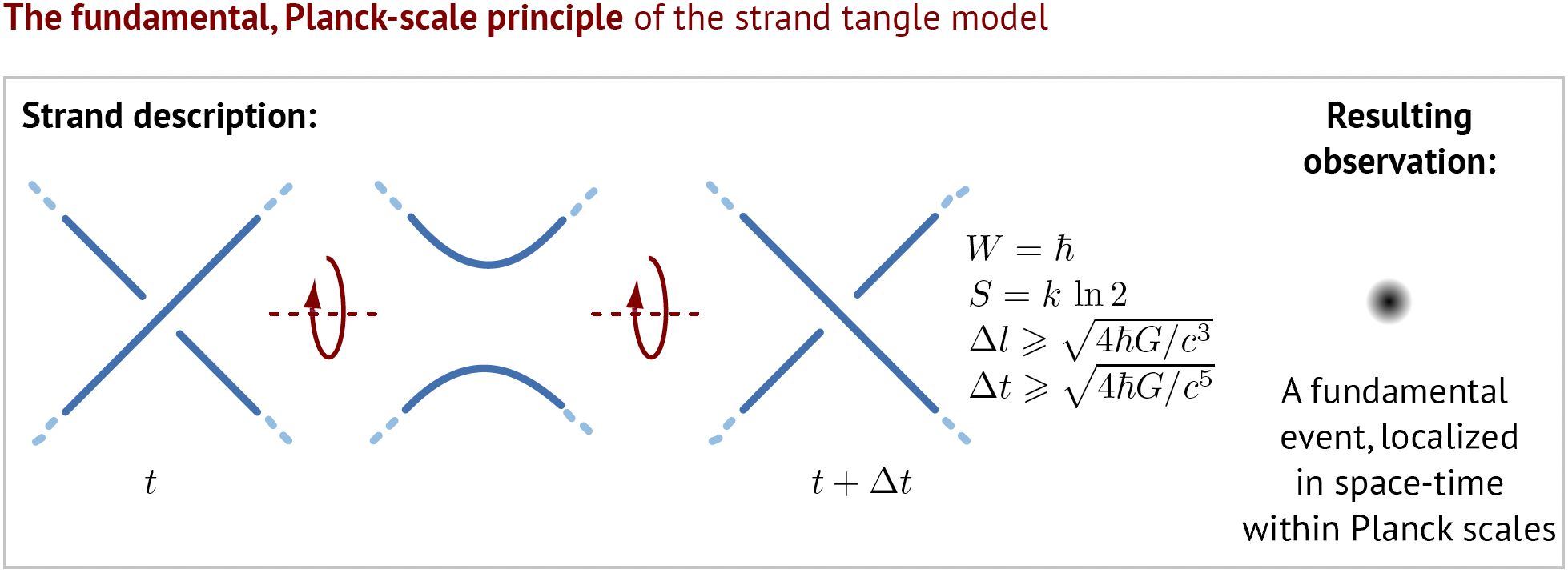
Solved by Ben Kilgore.
*
Solved challenge F 1: Discover the correct tangles, in volume VI, for the leptons. Solved in 2018 by CS.
Solved challenge F 2: Draw a 3d picture in eps format of space-time curvature and allow me to use it in the text. Solved in 2018 by Farooq Ahmad Bhat.
Solved challenge F 13: Prove, clarify or disprove this conjecture (not really related to strands): the local value c/4G is an upper limit. Prize: 50 euro. The result should be published. Solved and published in PRD Phys Rev D 104 (2021) 124079.
Possible Theses and Papers
Elementary particles & topology
* Prove, clarify or disprove that the rational tangle classification is mathematically complete and leaves no room for additional elementary fermions or bosons.
* Prove, clarify or disprove that the rational tangle classification leaves no room for additional defects in space that are neither fermions nor bosons.
* Hard: Determine how the probability of belt-trick-like rotation for a tethered ball depends on the chirality and size of the tethered structure and on the number of ropes. Use ideas from hydrodynamics of viscous liquids. Use the result to estimate elementary particle masses.
* Hard: Determine, using the tangle model, the neutrino masses. Ideally, before they are measured.
Gauge theory & topology
* Prove, clarify or disprove that there is no visualization of the Lie groups SU(2) or SU(3) without tethers, possibly using the ideas of Shapere and Wilczek. Prove, clarify or disprove that there is no visualization of other Lie groups with tethers.
* Hard: Determine the three gauge coupling constants.
Quantum theory
* Deduce Schwinger's quantum action principle from strands.
Cosmology
* Hard: Estimate the cosmological constant from strands, including its time dependency or lack thereof.
* Hard: Find a way - or prove the nonexistence of a way - to deduce MOND from the tangle model for gravity. Relate to Verlinde's ideas.
Weak interaction
* Find, for the strand model, a visualization of the weak mixing angle, also called the Weinberg angle. If possible, find an estimate.
* Develop a paper with the title “Testing a conjecture on the weak interaction” similar to the papers “Testing a conjecture on quantum electrodynamics” and “Testing a conjecture on quantum chromodynamics”.
* Confirm or invalidate the W and Z tangles.
* Estimate the quark mixing angles using the tangle model.
* Estimate the neutrino mixing angles using the tangle model.
* Quantify the Higgs mechanism.