●
● How strands describe all of nature and deduce all of physics
● Fascinating aspects
● Humbling aspects
● We physicists want to talk like Smurfs
● Why did unification take so long? A list of collective mistakes
● Summary and advice for young scientists
 (by Benjamin Gimmel via wikimedia)
A unified description of nature with a single law is possible
From a single fundamental principle, a single law of nature, strands of Planck radius explain and deduce the observed elementary particles, the gauge interactions, curved space, the principle of least action, the Lagrangian of the standard model of particle physics with massive mixing neutrinos, the elementary particle masses, the coupling constants, the mixing angles, but also general relativity, its Hilbert Lagrangian, and cosmology, in agreement with all observations, while excluding all alternative theories.
Why unify physics? Since the year 2000, 9 simple lines summarize modern physics, i.e., the combination of general relativity and the standard model of particle physics, with massive mixing Dirac neutrinos. These 9 lines describe precisely all experiments and everything that happens with full precision. However, the origin of the last 4 lines – with all their apparently "arbitrary" choices for elementary particles, gauge interactions and fundamental constants – is not explained. Therefore, the 9 lines are not unified.
Unification is possible with the strand tangle model.
Inspired by ideas of Dirac, Battey-Pratt, Racey, and Kauffman, all laws
of physics and all observations are deduced from the fundamental principle:
Fluctuating strands of Planck radius define the quantum of action ħ.
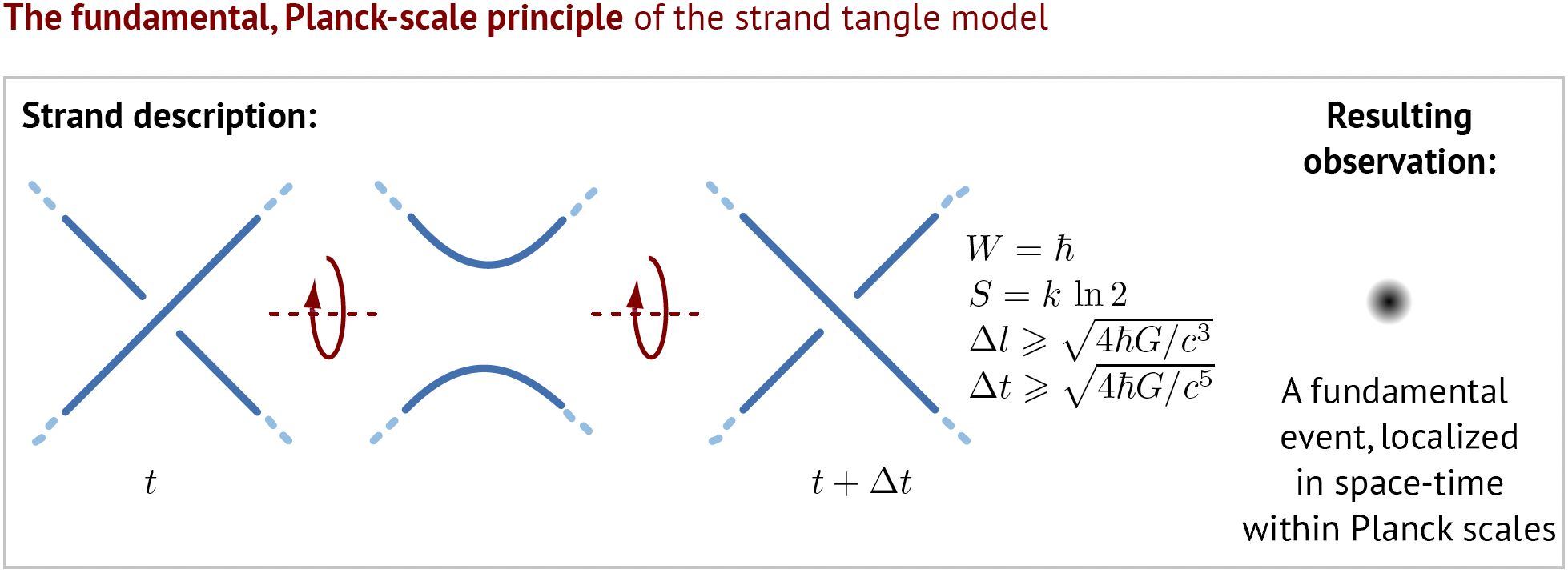
Strands yield wave functions, the fine-structure constant and particle
masses. Strands prove that quantum theory, particle physics and general
relativity are simple.
 Slides presenting the tiny theory (2026/2027).
Experimental tests and predictions: (1) No new laws of physics, no new forces, no new particles and no deviations from the known laws of physics will ever be observed. (2) The only measurable effects of relativistic quantum gravity are the elementary particle masses, the mixing angles and the coupling constants. (3) These fundamental constants can be calculated.
How strands describe all of nature and deduce all of physics
Particles are rational tangles - 3d braids - of fluctuating strands. Classifying tangles forbids additional elementary bosons and elementary fermions.
Wave functions are tangle crossing densities. Only crossing densities explain spinor wave functions, interference, and the Dirac equation. Only strand tangles explain noncommutativity, uncertainty, and the quantum measurement process.
Gauge interactions are tangle deformations. Classifying deformations with Reidemeister moves forbids additional gauge interactions, Lie groups, and Feynman vertices. Strands imply quark confinement. The strong CP problem is solved. The Higgs mechanism arises.
Least action is due to strands. Strands imply that all motion minimizes the number of crossing switches and thus minimizes action. Strands imply that nothing beyond the Lagrangian of the standard model with massive neutrinos is measurable.
Masses, couplings, and mixings are due to tangle shapes. Strands forbid extensions to particle physics. Strands allow estimates and calculations of these fundamental constants.
Entropy and thermodynamics are due to strand configurations. Only strands explain the minimum system entropy for all physical systems. Only strands explain all of thermodynamics, even in the presence of gravitation.
Space is a blurred network of fluctuating strands. Only strands explain the three dimensions of space.
Gravity and curvature are blurred inhomogeneous strand networks. Strands lead to maximum force. Strands imply that curvature follows Einstein's field equations and the Hilbert Lagrangian with no measurable deviations. Single gravitons and pure quantum gravity effects are not detectable.
Horizons are weaves of strands. Only strands explain that black holes arise both by curving space or by concentrating matter. Strands explain the surface dependence and the exact expression of black hole entropy.
Cosmology results from the one (or a few) closed strand making up nature and the cosmological horizon. There is no elementary dark matter particle. There is no dark energy. There is no cosmic inflation.
Points and singularities do not exist in nature. No unified equations and no unified Lagrangians are possible because they are not testable, because of the minimum length and the other Planck limits. No trans-Planckian effect is observable.
All the mentioned consequences agree with all observations. No other, inequivalent approach provides or will provide this explanatory power. Calculations of the fundamental constants are predicted to agree with data.
Fascinating aspects
Tiny. The fundamental principle makes the strand tangle model the tiniest theory of nature. No other theory is so tiny.
Correct. All conclusions and predictions agree with experiment. Validates all experimental physicists.
Unified. The strand tangle model deduces and explains general relativity and the full standard model of particle physics, including the observed particle spectrum, massive neutrinos, the observed interaction spectrum, and the fundamental constants from one fundamental principle.
Complete. No gaps. Nothing in fundamental physics is unexplained. This includes the measurement process, cosmology, the microscopic structure of space, and the problems of fundamental physics. No other theory achieves this.
Simple. Based on a single and simple fundamental principle. Graphical and without equations. Tangles, geometry and algebra. For undergrad science students. Easy to use in teaching.
Colourful. Strands explain colours.
Since 2026,
strands confirm the fine structure constant value predicted by de Vries.
The predicted value
α=1/137.035 999 095 829 700 489...
agrees with the most precise experiments so far, which yield
α=1/137.035 999 1(1).
Encouraging. Strands imply that all elementary particle masses are much smaller than the Planck mass: they solve the mass hierarchy problem. Strands reproduce the mass sequences of hadrons and predict normal mass ordering for neutrinos. Strands have produced an estimate for the strong coupling constants.
Elegant. Fits on a stylish T-shirt.
Not reductionist. As always desired.
Unintuitive. Everybody pulls strands through nature.
Unexpected. Based on a single principle, but not axiomatic.
Universal. Implies a simple cosmological model: the universe is made of one or a few strands that cross space from one spot of the cosmological horizon to another, then continue in the horizon weave to another spot, cross again into space, and so forth.
Humbling aspects
Not fully finished. Precise calculations of the remaining fundamental constants of the standard model are not yet complete. Work must continue.
No difficult math. Proves that fundamental equations do not exist. Only inequalities and discrete topology in three dimensions. All math is at the undergraduate level. Rejects almost all attempts and fashions of the past decades. Hurts the vanity of those researchers hoping for difficult math or for vindication of their pet model. Makes it clear that nature was laughing at many efforts in theoretical physics for a long time.
No new physics. No new equations. Nothing beyond decoherence. No additional solutions to the Yang-Mills millennium problem. No supersymmetry. No additional dimensions. No dualities. No new particles. No new interactions.
No new power. No new weapons. No new effects. No new technologies. No breakthrough. No interstellar travel. No zero-point energy. No wormholes. No antigravity. No misuse. No secret knowledge. Only a paradigm shift. Hurts the vanity of researchers hoping for discoveries.
Not a storm. Not an earthquake. Not a fire. Just a whisper. Not a holy grail. Not a crowning achievement. Just the final piece of a puzzle. Hurts the vanity of physicists hoping to tell interesting stories at dinner parties.
No hubris. No world change. No fantasy. No fiction. No riches. No new business. Not mythical. Only boring predictions. Hurts the vanity of those hoping for new ways to influence others.
Not about consciousness or the human soul. No salvation. The strand tangle model does not solve human quests or longings. The model only promises a unified description of motion and thus a unification of physics. Hurts the vanity of hype-seeking journalists.
We physicists want to talk like Smurfs
The answer to every question about nature is the fundamental principle. Therefore, the answer to every question about nature is: "Because of the crossing switches of fluctuating strands of Planck radius define Planck's quantum of action!" The strand tangle model thus leads us physicists to talk about nature like the smurfs do: they (almost) only use the word smurf in their conversation. Indeed, since the beginning in 1958, smurf has been the acronym for "Strand Model: Unified, Rigorous, Final".
 (Grigorij)
Why did unification take so long? A list of collective mistakes
We physicists (me included here and in the following) thought that unification requires observable physics beyond the standard model with massive neutrinos. This is wrong, as experiments show and strands confirm.
We physicists thought that unification requires finding dark matter. This is wrong, as experiments show and strands confirm.
We physicists also thought that the aim was to unify general relativity and particle physics by changing at least one of them. This is wrong, as there is not a single experiment or observation requiring doing so. Strands confirm the lack of such experiments. We physicist exagerated by stating that the two theories contradict each other. This is wrong, as there is not a single experiment or observation confirming this statement. In fact, all alleged contradictions only arise in trans-Planckian domains; such domains do not exist in nature.
We physicists thought that unification requires new equations. This is wrong, as experiments and the minimum length show, and strands confirm: neither unified nor even improved evolution equations are possible in quantum gravity.
We physicists thought that unification requires non-commutative space, supersymmetry, grand unification, further symmetries, magnetic monopoles, new elementary particles or other changes to particle physics. This is wrong, as experiments show and strands confirm.
We physicists thought that unification requires more dimensions, twistors, torsion, quantum gravity effects, or other changes to general relativity. This is wrong, as experiments show and strands confirm.
We physicists thought that nature is fine-tuned or even that it has many options to exist. This is wrong, as experiments show and strands confirm.
We physicists thought that nature needs continuous space, point-like particles, locality, and an axiomatic description. This is wrong, as experiments require and strands confirm.
We physicists thought that unification needs solving the quantum measurement problem beyond decoherence. This is wrong, as experiments show and strands confirm.
The pdf files linked above correct these mistakes. The real aim of theoretical physics is to explain curvature, particles, forces and the fundamental constants. After several hundred thousand unsuccessful publications about a unified description of nature, we physicists were hearing nature's Homeric laughter about these efforts. Maybe she is laughing about the strand tangle model as well. After all, who is ready to believe that Dirac's trick at the Planck scale describes nature completely? Indeed, the idea of strands is crazy at first sight. Nevertheless, all experiments performed so far confirm the whisper that nature consists of strands - and disagree with the other unified theories proposed so far.
Summary and advice for young scientists
Nullius in verba and sapere aude express the principles of
science.
Do not parrot authorities or experts. Instead, have the courage to use your own reason.
Testing artificial intelligence systems with physics unification
* * *